Dear Diary – Exploring Character Through Diary Entries…

This is an article on writing originally published in the June/July 2004 issue of WCDR Wordweaver.

Dear Diary, Today I Discovered…

Is writer’s block getting you down? Are you working on a story but find that your characters are withholding information about themselves? What’s stopping you from getting into their heads, taking hold of the dark and sunny contemplations lurking there and pulling out the ever-illusive back-story?

Knowing your characters is, at times, the hardest part of writing fiction. You can leave them in limbo for days on end as you agonize over their next moves. If they’re not willing to open up to you, you’re stuck.

But as their creator, you should be omnipotent. It’s your right to intrude on their privacy and find out what’s under the surface. There’s no better way to do this than to take possession of their minds and write their personal diary entries!

One day I was faced with a character I loved, but could find no means to carry him forward into my story. Struggling with his motivations, I couldn’t imagine what he’d do next. It was obvious that I didn’t really know who he was. That’s when I had an idea. Why don’t I just step inside his head and find out? He could tell me where he wanted to go.

You might think this sounds crazy. But one of my personal theories about writers is that we’re all just a few drops short of a river to begin with (i.e., we’re right-brained geniuses who are able to see the world around us as a constantly shifting wonderland filled with endless fictional possibilities).

Maybe this diary entry concept is a writing tool you already employ. But if not, I have a feeling you might be thinking, ‘Hmmm, sounds like a good idea’, especially those of you who have a minor character haunting your backstage, waiting to be thrust into the limelight of your story.

Diaries don’t form who we are, but they’re definitely a living record of that forming. You can’t read a person’s diary without knowing them a whole lot better afterwards. I’ve been keeping separate diary notebooks for years, exploring my characters in ways I never before could.

I simply write a character’s name and a date at the top of the page, throw myself into that character’s headspace and begin writing the entry.

I find that the date I choose is always helpful in this character study. If I choose a date years prior to my story, I can learn things about my character that have helped to form the way he reacts to certain situations.

For instance, if I explore a childhood entry I might find him writing about a traumatic experience and I suddenly understand why he is timid and skittish. Or I may choose a date a week prior to my story and discover why my character is in her present mood. If she writes about losing her job, her true love and her house all in one day, I’m going to understand why, on page two of my story, it makes perfect sense that she’s on the subway with unkempt hair, waving a loaded .45.

You can also write an entry that takes place two months after your story ends. Think of the possibilities this opens up! You might learn how to end your story by knowing what your character is going through in the future.

You’re the creator. This makes you the god of the quirky little worlds you create. When writing your story, don’t feel the need to trap yourself within its timelines. You have the right to move freely through time – something your characters can’t always do themselves.

Sure, you’ll feel like you’re being intrusive, like you’re somehow invading a sacred place. You might even sense people breathing over your shoulder as you write. But don’t worry. You’ll learn that your characters enjoy writing in their diaries. It gives them the opportunity to stretch their limbs and tell you a little about themselves; maybe they’ll even feel more real and validated.

The entries you create will definitely have an impact on your stories, even if what you write never finds its way into your narrative. Consider these entries as getting-to-know-you sessions. Never actually using the material does not make this a futile exercise.

On the contrary, you may find yourself on the fast track with loads of new material to work with. These people will have lives leading up to and away from your stories. You will have to write faster just to keep up with them! Now, where was I?

Oh yeah, ‘Dear Diary…‘

Writers – Fill Your Toolbox with Love Not Hammers

I wrote this a few years ago. It was originally published in the WCDR Wordweaver Newsletter. I think it’s a good reminder for writers everywhere…
writing
Filling Your Writerly Toolbox
Wouldn’t it be wonderful if the writer’s toolbox could include such a thing as a hammer! We could smash those uncooperative words to bits and smithereens whenever they decide not to mold to the articulations of our wandering thoughts. Sadly, this is not a very helpful tool to the creative force behind writing. We would tend to think of the hammer as Home Depot’s answer to that nagging internal editor… not very practical when creating. Perhaps we should leave it where it belongs… in the editor’s toolbox. They are more apt to use it with the care, precision and respect the weapon, er, tool demands.
What the writer should be able to find in their toolbox are flowers. And trees. And memories. And people. And voices. And birds. We should be able to open that box every day and walk into another world. Picture Narnia without the bulky wardrobe, Neverland without the hassle of learning the leap of faith needed to fly or even Wonderland without the bumps and scrapes accumulated from the fall that takes you there. We should be able to open our toolboxes and look in, reach in and grab out imagination itself. Whether we crack it open for a creative session of poetry or to write the latest freelance article on sleep apnea, we should be able to find helpful gadgets inside that will help us reach our eventual goal.
Writers should realize that the world around them is their toolbox. They should remember to take long walks in conservation areas, memorizing the texture of bark and the names of plants, trees and flowers. (Or even the taste and grit of dirt on their tongues, if they are so inclined.) They should sit on benches in malls and stare into the faces of strangers. They should collect scars, hairstyles and peculiarities from these people… write them down in notepads for future use. They should be in the business of accumulation, swallowing whole the world around them and spewing it back into their neat little toolbox for future excavations into the world of words.
Alongside daisies, alders and people–pictures that can be freely amassed–writers should also find at least one dictionary and an accompanying thesaurus. (We are never too old to learn new words and strengthen our vocabularies.) Leaning against their collected sounds of the ocean, and insects and wind, they should find a good reliable style guide. These things help to curb our tendencies to ramble, suggest to us the best possible way to present our thoughts. These are all good things, just as necessary to the process of writing as jumping off the edges of our imaginations to discover other more tantalizing worlds than our own.
Whatever you choose to arm your own toolbox with, you should make sure it contains a healthy balance. It should be two parts imagination, one-part reference books and maybe even one-part bravado… borrowed or genuine. If this is not enough, if capturing the world and squeezing it into the small confines of an imaginary toolbox is not quite enough to get you to where you need to go…take courses. Attend workshops in the areas that interest you. Never forget to squeeze mentors and teachers into that bustling box. Never underestimate the amount you still need to learn to improve upon what you already know about this thing called writing… this beautiful gift that is yours for the taking. Cultivating your gift with a well-stocked toolbox is the only way to show it the respect it deserves.

When 21 Seemed an Impossible Dream -The Cult at Strombo’s – Bonebag

In 1984 I turned 18. For most of the year, though, I was 17. I struggled. So much stuff swirling about my head at that time. Everything a secret…everything a wound, a laceration. I needed something.

Somewhere inside that year, The Cult released Dreamtime. On that EP was a song that had an extreme impact on me. Vulnerable, whipped, tired, bone-weary and too old to live…I finally found my theme song. There was one catch…I was not yet old enough to claim it as my own. Maybe…just maybe…if I survived a couple more years, I could sing the song and own its lyrics. But the mere imagining that I would live to the ripe old age of 21 was such an impossible concept…I just could not fathom it. Never in a million years would I live to see the day when I could say I was 21 and felt like I was 99. 21 was three or four years in my future. No way I could make it that long. The pain was too explosive.

But I wanted those lyrics to be my reality. I was always looking for something to propel me forward…a future signpost to keep me going in the right direction. A part of me always knew, even amid the chaos, that life was beautiful…that it was worth holding onto.

The song was Bonebag. And its message crippled me to the core, and simultaneously made a fighter out of me. I WAS bonebag. I swear, I wore that song out. When I was down–and I was down a lot back then–the song served to lift me higher. I’d listen to Ian Astbury bemoan the exhaustion of life through those words and it would sooth me, appease something in me not quite reachable by reason.

Yep. Too old to live. Not strong enough to stop living. In the slothenly trap of the ennui that surrounds, life goes on.

The Cult became a favourite rather quickly.

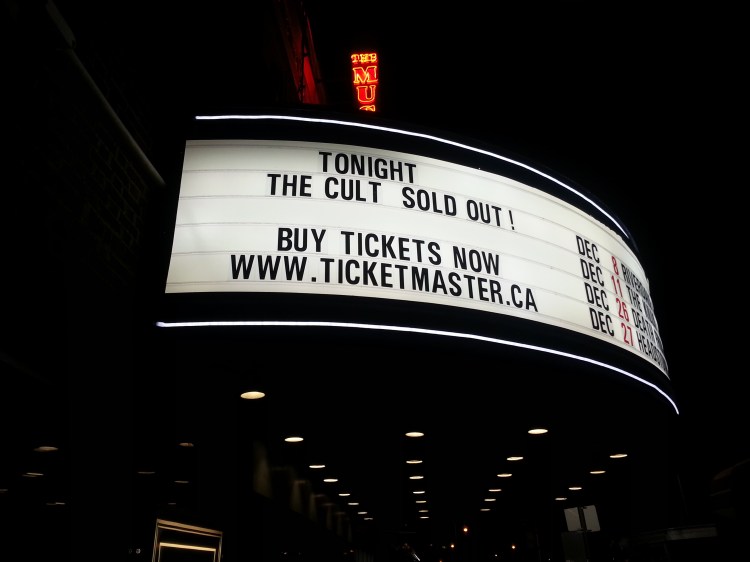
From an overly (overtly) romanticized blog post I wrote after seeing the band in 2013 at the Danforth Music Hall in Toronto:

Enter BONEBAG. That song grabbed me by the short ones and refused to let go. But Bonebag was just one of the fantastic songs on the EP. The Cult immediately spoke to me. They were medicine men arriving at the exact moment music was set to make an apocalyptic shift into the great shitter in the sky. Ian Astbury, Billy Duffy and the boys were mercenaries of rock. But not just rock…they were the bridge punk was desperately longing for. POSTPUNKGOTHICROCK. And Ian was some kind of mythical incarnation of the first Rimbaud in a leather jacket. He’s as much a Lizard King as his predecessor, JIM MORRISON. 1984 was a year of revival. Those of us who knew that music was about to die latched on to THE CULT with a quiet desperation and a deep blissful sigh. The Spiritwalker had come…and he gave us the Bad Medicine Waltz we were all waiting for.


marquee
The marquee outside the Danforth Music Hall, December 2013

I find it hard to speak of The Cult without going overboard. My passions run deep. There was a time when I latched on to things because I knew they were saving my life. The Cult was one of those things. I’m talking lifesaver in a turbulent storm kind of thing. They gave me a song with a future accuracy I could strive for. I was only 17/18, and I felt like 99 all the time. I wanted to achieve the right to sing the lyrics of Bonebag AS a 21 year-old. I know it sounds stupid…but there it is. Bonebag became my I-think-I-can song.

lizardking
Ian Astbury at the Danforth Music Hall – December, 2013

When you’re struggling to go forward, you grasp at all the little straws along the way. You can’t leave today… you’ll miss the next episode of Fame. You can’t leave today… you have tickets to see Alice Cooper in two weeks. You can’t leave today… you need to finish that Mark Twain novel you’re halfway through reading. Always an excuse to stay… always the wisdom to know that it gets better. Unless the wisdom vanished and you fell into another hole. During those times it was just accidental that you would survive.

I had several ports in the storm. The Cult was definitely one of them. Bonebag was one of them.

Thanks to George Stroumboulopoulos for having The Cult visit his place in Toronto last night for a quick 5-song set. And thanks to George for including myself and my daughter on the guest-list for last night’s gig. If someone had told my 17/18 year-old self that I would even live to see 21 and sing those riveting words “Only 21 but feel like 99 sometimes” I would have called them crazy. Here I am 49…feeling like 21 sometimes. And not only have I seen The Cult twice in stadium shows and once at the more intimate Danforth Music Hall…but I can now say I saw them in a house…in George Strombo’s living room.

Life takes twists and life takes turns. None of them are ever foreseeable. Some are unbelievable. I’ll chalk last night up to the unbelievable and amazing variety of turns. It was an event I won’t soon forget. Standing there, face to face with Ian Astbury as he powered through the 5-song list taped to the floor between us, I seriously gave thanks. Without knowing it, he and his band threw a song out there into the wilderness some 32 years ago…and it helped save a life. It was only my life, but it was still a life. Thanks George…and thanks to The Cult…for last night and for everything.

Sometimes it’s nice to remember where it is that we have come from… and how far we have come from there.

Edited to add the full 5-song set at Strombo’s House…which is now live!