From the first poem (A View from the Edge of the Earth) in the new collection from artist and poet Wendie Donabie, the reader understands her deep respect and awe for the beauty of our planet. And we also get the sense that she would do anything to save it.

This collection not only asks the reader to acknowledge and revel in the beauty of Mother Earth, but also to join in the fight to save her. These poems feel like an incantation to raise our hopes and to incite us to action. Infused with a bubbling anger for the place we have gotten ourselves to, the collection is also such a lovely love letter to what we still have and what we can reclaim if only we try.
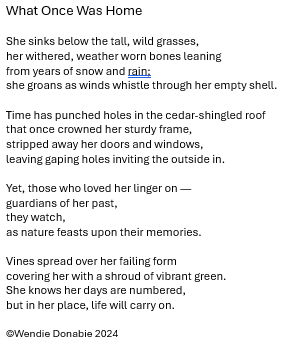
I’m SO thrilled that Wendie has shared both a painting AND its accompanying poem with us here! There is something hauntingly beautiful about a home in ruin. Here’s WHAT ONCE WAS HOME…

I first met Wendie Donabie through the Muskoka Novel Marathon and the Muskoka Authors Association, an organization which she co-founded with the indefatigable Cindy Watson. It was last year while following one of those curated trip packages from Toronto to Muskoka that I discovered Wendie’s artwork in the wild! Wow! Her art is as gorgeous and as powerful as her poetry.

I’ve asked Wendie to partake in my Proust(ish) Questionnaire and I was thrilled when she agreed! As usual, I feel as though this is something I actually thrust upon victims! They don’t know what they’re getting themselves into until I actually send the questions over. Once again, I’m thrilled that my ‘victim’ has been a great sport about things and humoured my voluminous list of questions!
Before we go there, though, here’s one of Wendie’s latest creative offerings…
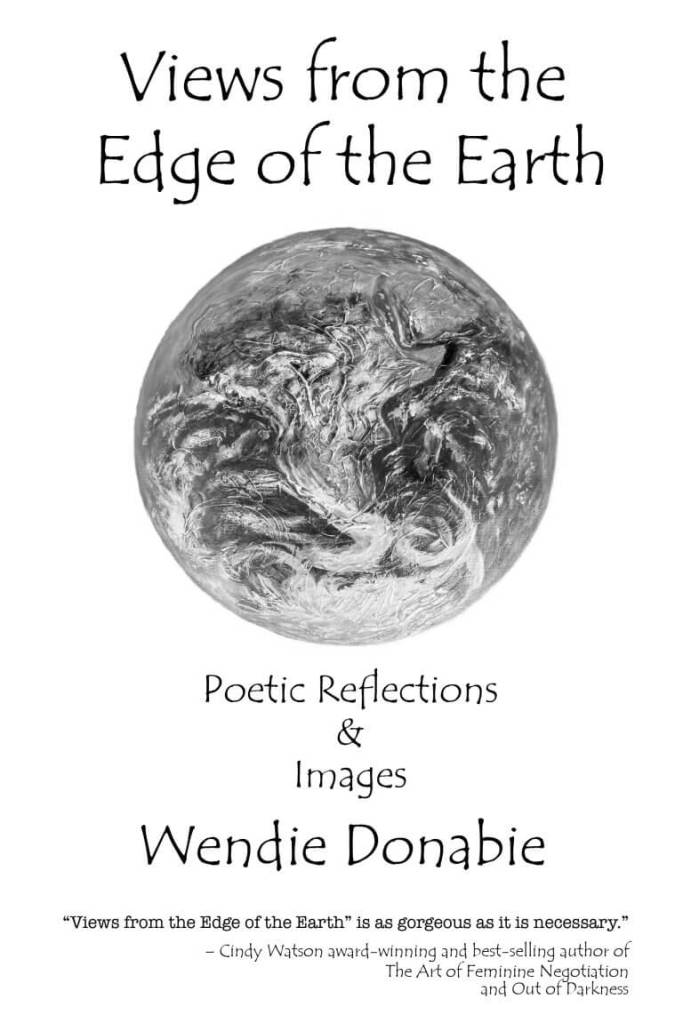
Click the cover above to be taken to Amazon to pick yourself up a copy of Views from the Edge of the Earth. You’ll be swept away by the beauty and fierceness of Wendie’s words. Not to mention the beautiful photos and paintings. Not only does her book of poetry celebrate the gorgeous planet we call home, but it also displays that beauty in her flawless works of art that capture it.
Now, on to my Proust(ish) Questionnaire…the WENDIE DONABIE edition!
- What is your idea of perfect happiness?
Being deeply engaged in a thrilling mystery or suspense novel, something with a twist, an unfamiliar perspective that whisks me away to place or time I’ve not experienced. What makes this ideal is being in a place where I can view nature outside and having my spouse somewhere nearby.
- What is your greatest fear?
Losing my spouse and failing to do something meaningful with my life.
- What is your most preferred genre as a reader?
Definitely mystery with an element of the paranormal or magical realism.
- What else do you write, besides poetry?
I am currently working on a double murder mystery with a touch of the paranormal. The story involves a current murder, and a cold case both committed with the same weapon, set in a place that looks much like Muskoka.
Editorial Intrusion: This sounds AMAZING! I can’t wait to read it!
- Which writer do you most admire and why?
There are so many. I love everything written by Alice Hoffman for storylines filled with magic realism and characters so real they live with me long after I finish her books. Also recently, I would say A. J. Hackwith is a favourite. Her series about a library in hell is believable – great characters, unique settings, and intriguing storyline.
- What do you consider the most overrated virtue?
Examining the listed virtues on the internet, I discovered DETACHMENT – didn’t know it was a virtue. I am not one lacking in emotion or personal interest in people or situations.
- A clear takeaway from reading your book of poetry is that you’re passionate about the Earth and conservation. For those who wish to do something to help save our planet, but find things so overwhelming, where would you suggest as a great starting point? Are there baby steps we all could be taking?
Our lives are so busy; we need to slow down, spend time in nature to breath in, to see, to hear, to feel. We need to become more mindful to understand how we are part of the life on the planet – not separate from it. Take a walk in a city park, hike in a forest, spend time by water, these are all activities that can reconnect us with Mother Nature. By doing this, we begin noticing things, like garbage at the side of the road. This might spark the idea of organizing a neighbourhood clean up.
Other practical ideas are being vigilant about recycling, buying less plastic, composting where possible, watching water and hydro consumption, installing heat pumps, planting pollinator friendly gardens, installing bee boxes for those mason bees, planting milkweed for Monarch butterflies. There are so many online resources – just research on GOOGLE, what can I do to help the environment.
These things may seem insignificant, but every small step has impact.
- How long did you work on Views from the Edge of the Earth? And did you write the poems specifically to make up this collection, or did you one day realize that you had accumulated enough of a body of work with a common theme to put it together?
The actual process of compiling the book took only around five months but the writing has been going on for years. Part of the collection includes a selection of poems I wrote in the 1980s while spending time in Cape Cod. The rest were written over the last few years, in part during the Muskoka Novel Marathons, but mostly during Poetry Marathons held online by Caitlin and Jacob Jans of Authors Publish. Each year they host this event with hundreds of writers from around the world. Participants write one poem per hour for either twelve hours (Half Marathon) or twenty-four (Full Marathon). I chose the Half Marathon knowing I couldn’t stay awake for twenty-four hours. Prompts are offered which I sometimes responded to but for at least two of these sessions, I chose to use my paintings as inspiration. The natural world informs my artwork, so the resulting poetry reflected my experience with nature.
I’d been writing poetry on and off for years so in the fall of 2023, I decided to see if I had enough work for a book. My poems covered a variety of subjects, so I tried to figure out a way to organize them all. During that process I realized the majority were about Mother Nature. I didn’t want to do chapters or sections; instead, I arranged the book more as a journey through the natural world.
Now I needed a title. In last year’s Poetry Marathon, I drafted the opening poem of the collection, A View from the Edge of the Earth. It was from a prompt to write a poem from a view on the edge of a flat earth. I conjured this dramatic image of our Earth with humanity falling off the edge into hellfire. The poem inspired the title for the collection, Views from the Edge of the Earth, encompassing the idea of my experiences with the Earth.
For the preface I reached back to a piece of prose created in 2014 for a Mother’s Day event in Muskoka, Mother Earth – the Mother of Us All. This short essay went on to win Gold in the August 2014 issue of Art Ascent Magazine. And it provided the perfect foreword for the poetry collection that launched in June 2024.
- When I first started reading Views from the Edge of the Earth, I had the real sense of the trouble we are in. You pulled no punches. But as I progressed through the reading, it really opened up to joy and beauty. It gave me a sense of how lucky we are. I particularly loved the poems that focused on trees. I think it began at Tree of Life, but trees were also peppered throughout and explored in the grouping of winter poems. These poems made me want to return to the forest! Your landing poem, If I knew Magic, seems to be a mix of the two extremes…a dire warning, and a sense of magic that allows us to believe that we CAN make a difference…a change. You left us hopeful. What’s the next step? For you? And what should our next steps be as readers?
For me it’s working every day to be more aware of what I am doing to help or harm our planet. It’s a daily practice. I believe in the butterfly effect – that the small things we each do can have far reaching ramifications. Living by example is what I try to do but I’m no saint and I don’t always recycle properly or conserve in the best ways. However, I do my best and I think that’s what we all can do.
Some people are called to greater advocacy and activism roles, and I admire those folks. For my part, I also support organizations doing important work to bring about healing and change on the planet.
- When and where were you most afraid?
After my late husband died, I would lie in bed at night and worry about dying and no one knowing.
- Which talent would you most like to have?
I would love to be able to instantly recall details from my life, people’s names, experiences, places I’ve been and to draw on this information for storytelling.
- If you were to die and come back as a person or a thing, what would it be?
A wealthy philanthropist with compassion and insight who could influence and bring about change in the world, help solve world hunger, bring diverse factions together, help the world find common ground as sisters and brothers.
- Which came first…visual art or words? I know this is sometimes a difficult question to answer. I can’t remember when the two things were separate in my own life. They seem to walk hand in hand. For you, did you come to them separately…or all at once?
I started out quite young in photography and still take tons of pictures. Both writing and art came in my twenties although I had wanted to write and paint as a child but never had the confidence.
- What are your three deserted island books?
A book about how to live on a desert island and two blank books to write in.
- Do you ever have reservations about sharing your creations with the world? What medium makes you feel the most vulnerable when it comes to sharing?
I believe in overcoming my fears by doing and so I share my work, with trepidation at times, but without reservation.
The night before my book launch I started questioning my sanity. Who did I think I was authoring a book? Who was going to like it? It probably wouldn’t sell. Those thoughts plagued me for a short while but then I started getting feedback from readers about how much they loved the book, a particular poem or a memory that was rekindled for them. I love hearing how the poems effect people and why.
For my art, my first exposure was stressful, and I still probably feel most vulnerable about my paintings. I was in a show with artists who’d been painting for much longer than me and my work was not up to their calibre. Now, I’m more comfortable with my pieces as I realize they come from me and me alone; I’m not like any other artist or writer. Not everyone is going to like what I do or identify with it and that’s okay.
- Can you tell us what your favourite poem from this collection is? If it’s too hard to choose, are there any that you’re particularly proud of? I sometimes finish a poem and feel that I finally connected with something. I look back at those poems with a sense of pride…like I finally allowed myself to get out of the way and let the poetry come through from that sacred place. Did any of these poems feel like that to you? Little gifts from that place?
It is really hard to choose, but I think the one I feel proudest of is What Once Was Home. I loved the painting that inspired it too. We were on the east coast two years ago on vacation and drove by this deserted house. I hollered, “Stop. Go back.” I took a series of reference photos for use in the studio. I find old, deserted building so full of character and spirit. When I wrote the poem it spoke to me of the natural cycle of life and interplay of all life on our planet.
Yes, I understand what you mean about a poem coming from a sacred place. The one that feels most like that is A View from the Edge of the Earth. It was unlike anything I had ever written before, and it felt like the right message to open the book.
- What sound grates on you more than any other?
Someone chewing food loudly or with their mouth open – that wet, squishy sound and smacking of lips. Yikes!
- How would you like to die?
In my sleep after a wonderful day spent with the ones I love. If my body were wracked with illness and pain, and I no longer had any quality of life, I would choose MAID (Editorial Intrusion: Medical Assistance In Dying).
- What sound brings you deep joy?
Birdsong and a baby’s unrestrained giggles of joy.
- What is your motto?
I never thought I had a motto before, but this feels right: “Love always.”
I absolutely LOVED Wendie’s answers here! Thank you so much for taking the time to humour so many questions, Wendie…even the slightly weird ones. I appreciate your time and I appreciate YOU!
Pay particular attention to Wendie’s answers to QUESTION 7…there are so many small things we can do to bring about change and hope for this beautiful planet we live on.
Now…go forth and pick up a copy of Wendie Donabie’s book of poetry VIEWS FROM THE EDGE OF THE EARTH: POETIC REFLECTIONS AND IMAGES!

 KEVIN CRAIG