I know I’ve been talking a lot about the Muskoka Novel Marathon lately, but I can’t help it. It’s coming. Like a freight train that sneaks up on ya when you’re walkin’ the tracks and singing old Buddy Holly tunes. Or…yeah! Blancmange! Something something about a train going down a track…
The atmosphere of the marathon is such a magical non-quantifiable thing. You cannot write about it and do it justice. You just can’t. You try to stay up all weekend, you write non-stop…but you also socialize non-stop. You eat non-stop. You listen to music non-stop. Skip the light fandangle, et cetera, et cetera. It’s a high like no other.
As if there isn’t enough going on to warp your mind, you step out of the building on the Saturday night and the streets are turned into a carnival of milk chocolately, caramel stickable gooeyness. Because…don’t close your eyes…you have walked into the strange and magical world of Nuit Blanche North. Art installations and crickety crawling stilt-walking juggling sensations. And what would a Nuit be without a fire-eater.
(Just a side note, I love that most of my words today are being underlined in red squiggly lines.)
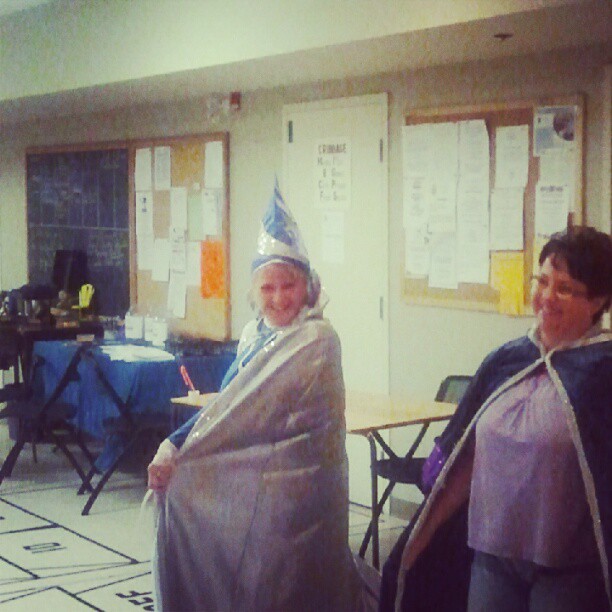
I always think of that classic line from Bill & Ted when I’m at the marathon. “Strange things are afoot at the Circle K!” That pretty much sums up the marathon. Just when you think you have to get outside to embrace a reality that is NORMAL, you walk out into this:
 And this:
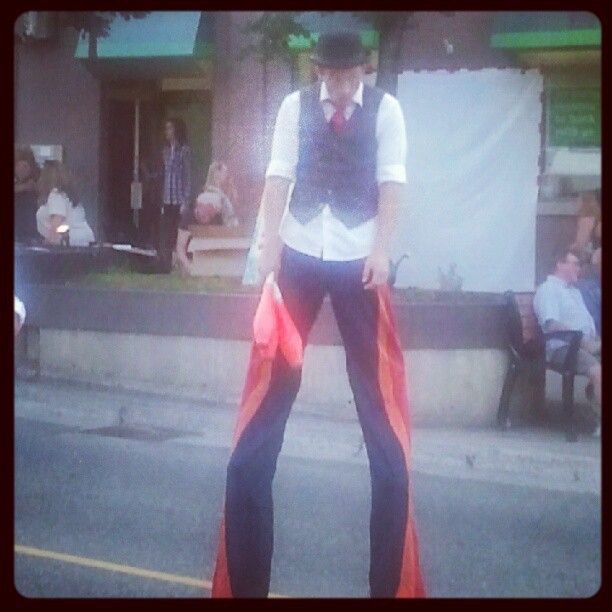 But before you run off down the street like a madman, you take a hard look at your surroundings and you realize that things are just as they should be. Writing a novel in a weekend SHOULD be a magical experience. Your heart SHOULD stop every now and again. You need these moments of wonder peppered throughout the weekend. It’s another classic reason for me to haul out that overused saying of mine. “Don’t be afraid to eat the dishes!” You’re gonna have some hard times over a 72-hour writing period. You’ll get cranky. You’ll get tired. You’ll get bloated. You’ll get indigestion out the wazoo! You need to step out of the world and into a carnival.
I’m sure that’s why the city planners threw Nuit Blanche into our weekend. They knew that into every novel marathoner’s life, a little magic must fall.
 The tree that you see above ^ is a tree completely wrapped and enshrouded in TIES. Yes, ties. I sat beside that tree for about half an hour before I saw it at last year’s marathon. At first, that scared me. But when I stopped to think about it, it was pretty par for the course. I was, after all, writing. We marathoners took turns writing in the street in downtown Huntsville. We were our own art installation…and we collected a nice sum of money for the cause (the literacy program of the YMCA of Simcoe/Muskoka). If you see us out in the middle of the street this July, BRING MONEY!
 I guess the lesson there is DON’T EXPECT TO QUESTION THE EFFICACY OF A TIE TREE WHEN YOU’RE MARATHONING. Or something like that.
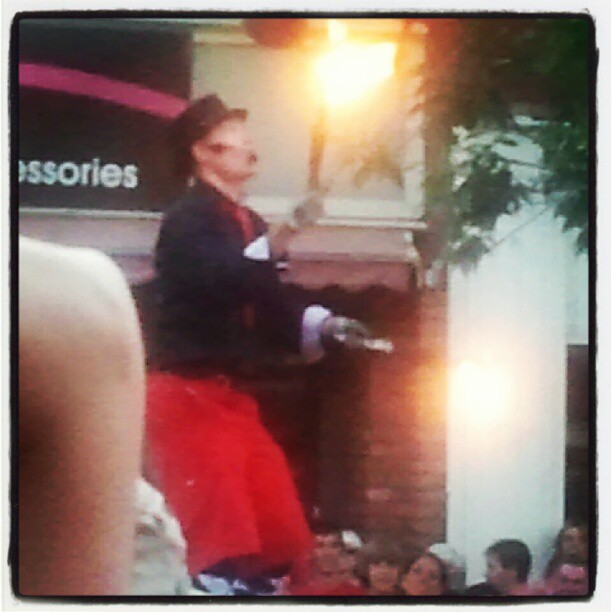 Did I say juggling fire-eaters and stilt walkers? I think I meant fire-juggling stilt-walkers.
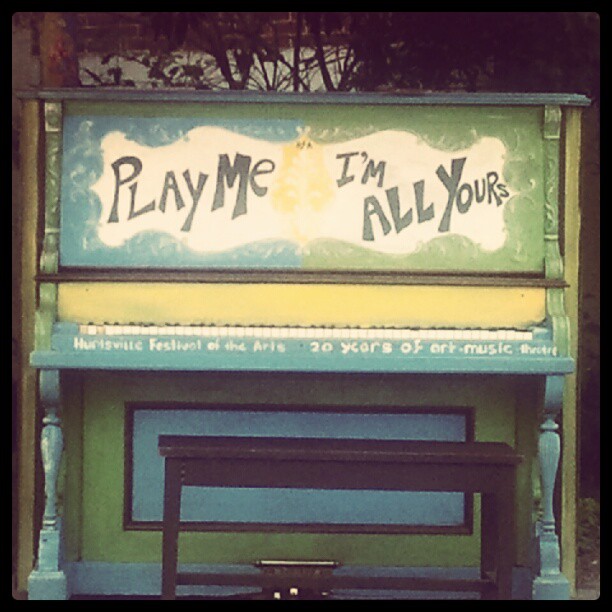 You’ve heard of the player piano, I’m sure. But did you know that Huntsville had a play-me piano. Right there in the street. Just waitin’ to be played. How frickin’ awesome-sauce is that! My only complaint? I DON’T KNOW HOW TO PLAY A PIANO! I wish I did. That corner of the downtown core would be hoppin’! This year, one of my goals is to get a fellow marathoner punchin’ those keys to an awesome sing-a-long song. Or something like that.
 WRITING! It really does happen at these things! I have 5 novels to prove it. This is a shot of my screen during Nuit Blanche. If you want to know the height of exhilaration and dare-devilness, just write a novel in the street while hundreds of people are walking by reading over your shoulder! YIKES. Okay…I know you’re probably thinking that jumping out of an airplane is a whole new plateau of exhilaration that is miles above writing in the street. So what. By it’s very nature, it would have to be at least a mile above a street. There’d be no exhilaration jumping out of an airplane that’s parked on the runway. For a writer, public writing under a microscope pretty much does it for adrenalin rush-hour kicks.
So, am I excited for this year’s Muskoka Novel Marathon? Nah. Nothing good ever happens at these things. Just. BIC (bum-in-chair) writing. Nothing else. Move along. Nothing to see here (or do I mean see-hear-smell-touch-taste?)!

 KEVIN CRAIG