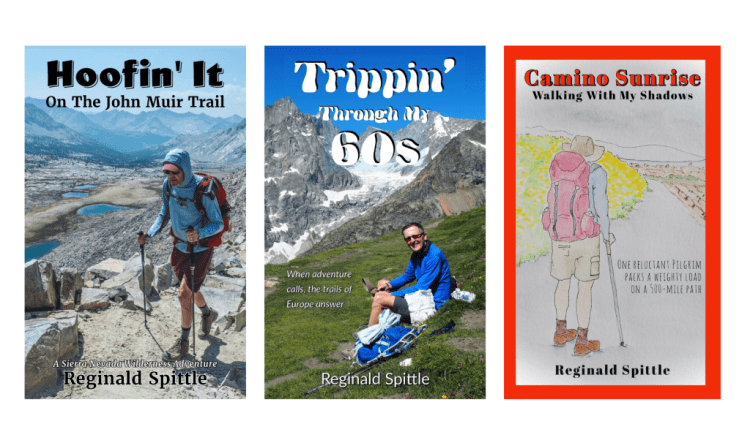
It’s time once again to highlight a fellow author! Today, I have a hiking/Camino friend on board for the Proust(ish) Questionnaire. Reg Spittle is a fellow Camino walker who has now authored three books. His latest, HOOFIN’ IT On The John Muir Trail: A Sierra Nevada Wilderness Adventure, was released in January. I’m about halfway through it and already dreaming of walking the John Muir Trail. I absolutely loved his Camino Sunrise: Walking With My Shadows. He brings the same honesty and silent reflection into Hoofin’ It that he introduced in Camino Sunrise. You can see transformation on the page.
Reginald Spittle is a retired political science professor and longtime newspaper journalist who once considered walking the Camino de Santiago pilgrimage route across Spain on the Camino Frances. When his self-doubts and insecurities had him thinking, “I can’t do that,” his wife’s response was, “What if you can?” So they did. I think it’s safe to say they have not looked back.
Reg, standing atop Mount Whitney, highest peak in the continental USA at 14,505 feet (the sign is off by 3 feet).
Reg’s latest book is the culmination of his wondering if they’d be able to walk the John Muir Trail. Spoiler alert: They did it! Today, I ask Reginald Spittle to partake in my Proust(ish) Questionnaire. So glad that he agreed to do this. Twenty questions may not seem like a lot to ask someone, but I’m sure it’s quite time consuming to answer them…so a thousand thank yous to Reg for being a great sport and taking part! Let’s face it, twenty questions is a downright lie. Some of these questions have two, three or more parts.
Before we get into the questions, here’s Reg Spittle’s BIO:
Reg Spittle and his wife Sue raised three sons in the shadow of Yosemite National Park, exploring its many trails. As an educator, Reg won a yearlong teaching exchange in Scotland, taught all seven elementary school grades during 20 years in California, and instructed political science for 11 years at a California community college. He was a journalist at five newspapers.
He could not have anticipated the new experiences that awaited him in retirement. Sue and Reg have walked eight distance trails in seven countries, covering more than 2,000 miles. In 2023, they walked 500 miles on the Le Puy Camino route in France. They have also crossed the USA five times in their truck and travel trailer, visiting 46 states and four Canadian provinces.
Now. Let’s get into it, shall we…
1. What is your idea of perfect happiness?
Perfect happiness doesn’t exist. I try to focus on incremental accomplishments, like writing a chapter in a book that will lead readers to eagerly anticipate the next page. Or spending a day on a trail that satisfies me because of its challenges, scenery, and physical exercise. Even if these things are not fun in the moment, time usually offers fresh perspective. The most difficult pursuits in my life have been the ones that have brought me the most positive feelings.
2. Do you know what your next great adventure will be? And…do you now go into your adventures with a plan to write about them?
During spring 2025, Sue and I are walking an Italian section of the Via Francigena, a pilgrimage to Vatican City that begins in Canterbury, England, and has been walked for hundreds of years. Then we plan to walk the Cotswold Way in England after rests in Rome and York. I will probably keep a journal, like I did on the John Muir Trail. I did not go into the JMT with the intention of writing a book, but I knew there was a book there long before the trek was even finished.
3. What is your greatest fear?
Health problems that keep me off the trails, or losing mental sharpness.
4. What is your most preferred genre as a reader?
Young adult fiction and non-fiction, particularly books that portray young people who have overcome difficult childhood challenges. And, if I may, there is a second genre I am drawn to just as much: adventure stories about people who have traveled long distances by foot, bike, or boat. There are so many great books about incredible human travel accomplishments. I just finished Dove, about a California teenager who became the youngest (at 16) person to circumnavigate the globe in a sailboat—solo!
5. Which writer do you most admire and why?
The late Gary Paulsen, the author of a sky-high pile of fiction and non-fiction books. He wrote several survival stories that took place in wilderness settings. Many of his characters, who discovered courage that they never imagined possible, remain in my heart. His best books? Two—Hatchet and Canyons—are my favorites. I read these to my sons and to several hundred children in my classes. I encouraged my students to doodle or sketch while I read aloud, but often, while I read Paulsen’s books, their pencils remained still while they hung on every word. I owe you big time, Gary.
6. How do you decide what to do next? There are so many options out there for wanderers to choose from. What criteria do you use to decide? Is it random, or do you listen for a calling? (I threw that last part in there because I truly believe the Camino is a calling. You hear about it one day and it doesn’t let go until you decide, “Okay, I’ll do it…”)
You are so right; the world has many lifetimes worth of distance trails. When we read and/or watch YouTube videos about a trail, if we are drawn to it, we look for blogs and reviews of the trek. If it catches our fancy, we order a guidebook to look at the trail in more detail. (We have quite a library of guidebooks, I tell you!) We read the guidebook and debate it for a while. Sometimes, like with the Via Francigena in Italy (which we are walking in April 2025), we return to consider a trail we had previously put on the back burner. In the case of the John Muir Trail, our son Chris, a big Sierra Nevada backpacker, had lobbied me for years to do the JMT. “You can do it, Dad. And you’d love it!”
7. What do you consider the most overrated virtue?
Being positive all the time. It is unnatural, and I sometimes find it toxic.
8. What did you take with you on this journey that you wished you hadn’t packed and what did you not have that you wished you had packed?
We took a solar shower and never used it because it was too much trouble to set up and there was (freezing) water everywhere to rinse off in. Oh, how we longed for more snack food. We got so tired of Clif bars and wished we had provided for more variety. I envied people who carried squeeze peanut butter and tortillas. At high altitudes, your body needs far more calories as it works in high gear to cope with the lower oxygen levels, as well as the challenging ascents.
9. For those considering the John Muir Trail, what advice do you have for them as far as preparation training goes?
Acclimate to the altitude. We spent three days just before the JMT in Mammoth Lakes, a resort community in the eastern Sierra at about 8,000 feet. Each day, we walked at 10,000 feet or more. You need to be in reasonable condition, able to walk 10-12 miles a day carrying a backpack. Be sure to include some days with challenging ascents and descents and walk on a variety of surfaces to make sure your shoes/boots will work. Train with trekking poles, which are musts on the JMT. There are several Facebook groups that offer loads of advice.
10. When and where were you most afraid?
I was most fearful before the trek, at home. I worried that I had gotten myself into an adventure beyond my capabilities. My failures as a kid whenever I faced physical tests came back to haunt me in the middle of several nights. Then, on the first day of the JMT, I felt like a rookie among pros when we met our fellow trekkers, most
of whom had been on the JMT before. I had never done a wilderness trail, which is so different than the European trails we had walked. During the trek, I was on edge several times, but I don’t recall ever being afraid, even on Mount Whitney.
11. Which talent would you most like to have?
Confidence in myself, especially in challenges that test my physical abilities. It has held me back from many experiences, but the John Muir Trail was a huge boost in making me feel better about my skills on the trail.
12. If you were to die and come back as a person or a thing, what would it be?
I would want to come back as a kid who was athletic, living in a family that loved the outdoors. I would grow up with an incredible friend who was filled with an adventurous spirit. After high school, my friend and I would set out on wilderness treks like the Pacific Crest Trail or the Appalachian Trail, spending many months, or even years, on the trails. We would also backpack in Europe and maybe other continents, getting jobs now and then to see us through. We would make new friends along every trail. Would we ever grow up? In a way, I hope not.
13. After walking/hiking both the Camino de Santiago and the John Muir Trail, which do you prefer? Also which would you recommend to someone who has done neither? I ask this question knowing that the two must be as different as night and day (Albergues vs. Camping, etc.).
It is a bit like asking which of my three sons I love most. Because I am truly in love with each distance trail I have walked, for reasons unique to each one. (Much like how I feel about my kids) But, if I were to choose the most memorable trail that fills my heart the most, it would be the John Muir Trail. Or perhaps the Camino de Santiago, our “first born.” Or…
For me, the Camino de Santiago was an ideal introduction to long-distance walking. It has a great infrastructure, a welcoming culture, and allows flexibility in daily distances. It is the granddaddy of European trails and we met people who became lifelong friends. But it is not for everyone. If you are a strong hiker with backpacking experience and prefer a quieter, less traveled experience in a more remote location, then the John Muir Trail may be for you.
14. What are your three deserted island books?
Hatchet, by Gary Paulsen. Siddhartha, by Herman Hesse. The Four Agreements, by Don Miguel Ruiz.
15. Keeping to some of the hiking theme going on in these questions, let’s talk GEAR! Specifically shoes/boots and backpack. Knowing that shoes especially are a very personal thing, what do you suggest for both? Do you have a favourite shoe or backpack?
I just bought my fourth pair of Altra Olympus trail runners and will wear them on both European treks this spring. They are lightweight, wide-toed, and breathe well. (But I don’t advise that you test them by getting your nose anywhere near my socks at the end of a day.) I get a size 12, at least a half-size larger than I normally wear
16. Can you tell us something you’ve read recently that’s really made an impact on you…either good or bad?
The Unteachables, by Gordon Korman. It reminded me to avoid assuming why a person behaves the way they do, because I really have no idea until I give them a chance. Everyone who has ever been a student or teacher, or both, should read this book.
17. What sound grates on you more than any other?
Loud music or a barking dog on a trail or in a campground.
18. How would you like to die?
In my sleep, after some wine and a nice dinner with Sue. I tell friends I would rather die on the trail than in my rocking chair.
19. What sound brings you deep joy?
A favorite playlist on my AirPods, while walking in Lithia Park in my hometown of Ashland, Oregon.
20. What is your motto?
Speak impeccably. Don’t take things personally. Never assume. Always do your best. (From the book The Four Agreements, see Number 14.)
Such fantastic answers! I really loved reading these replies. What struck me the most is how aligned some of his answers are with how I would respond. I almost fell off my chair when he mentioned Gordon Korman. This is an author who visited my school library to talk about his new book WHO IS BUGS POTTER? back in 1980. I don’t even understand mathematically how Gordon Korman was writing books in 1980 when I was in school when today he is 61, not even three years older than me. But I digress. I thoroughly enjoyed Reg’s answers to these questions. If you want more of Reg’s words, I highly recommend you pick up one or two or three of his books!
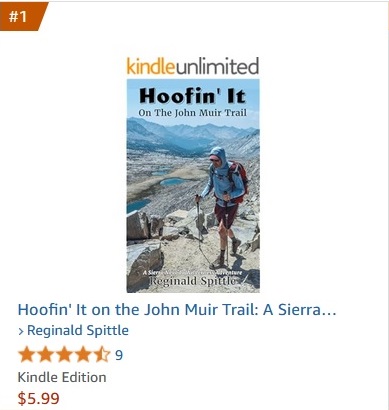
Congratulations on the Orange Banner! Reg’s latest is a Hot New Release!
Congratulations on your latest book, Reg! I’m really loving it and I can feel myself adding the John Muir Trail to my ever-growing bucketlist as I read. Thanks so much for being sport enough to answer all these questions. Good luck on the Via Francigena in April! I look forward to hearing about the adventures you will have on that famous route!
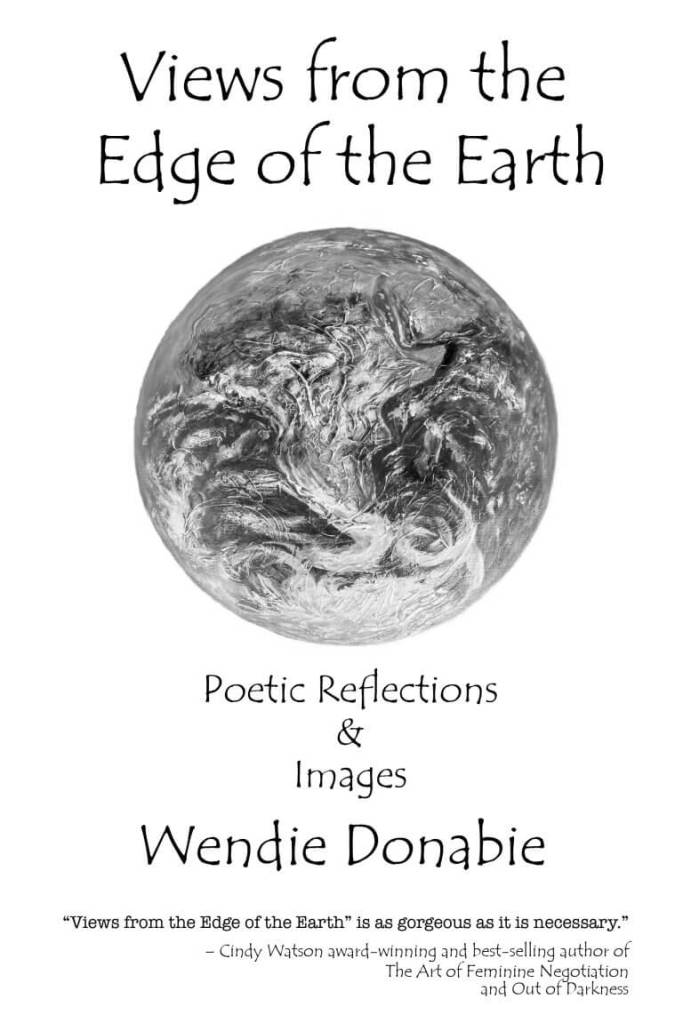
From the first poem (A View from the Edge of the Earth) in the new collection from artist and poet Wendie Donabie, the reader understands her deep respect and awe for the beauty of our planet. And we also get the sense that she would do anything to save it.
This collection not only asks the reader to acknowledge and revel in the beauty of Mother Earth, but also to join in the fight to save her. These poems feel like an incantation to raise our hopes and to incite us to action. Infused with a bubbling anger for the place we have gotten ourselves to, the collection is also such a lovely love letter to what we still have and what we can reclaim if only we try.
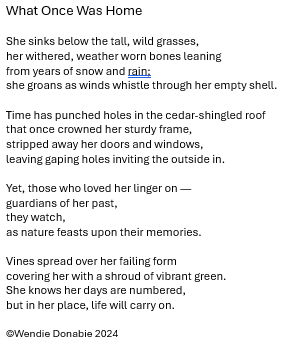
I’m SO thrilled that Wendie has shared both a painting AND its accompanying poem with us here! There is something hauntingly beautiful about a home in ruin. Here’s WHAT ONCE WAS HOME…
I first met Wendie Donabie through the Muskoka Novel Marathon and the Muskoka Authors Association, an organization which she co-founded with the indefatigable Cindy Watson. It was last year while following one of those curated trip packages from Toronto to Muskoka that I discovered Wendie’s artwork in the wild! Wow! Her art is as gorgeous and as powerful as her poetry.
One of Wendie’s pieces that I came upon in a small art gallery in the woods beyond the gorgeous historical octagonal Woodchester Villa in Gravenhurst, Ontario. If you zoom, you’ll see a beautiful Northern night skyline on the blade of the oar.
I’ve asked Wendie to partake in my Proust(ish) Questionnaire and I was thrilled when she agreed! As usual, I feel as though this is something I actually thrust upon victims! They don’t know what they’re getting themselves into until I actually send the questions over. Once again, I’m thrilled that my ‘victim’ has been a great sport about things and humoured my voluminous list of questions!
Before we go there, though, here’s one of Wendie’s latest creative offerings…
(Photo of book cover courtesy Wendie Donabie)
Click the cover above to be taken to Amazon to pick yourself up a copy of Views from the Edge of the Earth. You’ll be swept away by the beauty and fierceness of Wendie’s words. Not to mention the beautiful photos and paintings. Not only does her book of poetry celebrate the gorgeous planet we call home, but it also displays that beauty in her flawless works of art that capture it.
Now, on to my Proust(ish) Questionnaire…the WENDIE DONABIE edition!
What is your idea of perfect happiness?
Being deeply engaged in a thrilling mystery or suspense novel, something with a twist, an unfamiliar perspective that whisks me away to place or time I’ve not experienced. What makes this ideal is being in a place where I can view nature outside and having my spouse somewhere nearby.
What is your greatest fear?
Losing my spouse and failing to do something meaningful with my life.
What is your most preferred genre as a reader?
Definitely mystery with an element of the paranormal or magical realism.
What else do you write, besides poetry?
I am currently working on a double murder mystery with a touch of the paranormal. The story involves a current murder, and a cold case both committed with the same weapon, set in a place that looks much like Muskoka.
Editorial Intrusion: This sounds AMAZING! I can’t wait to read it!
Which writer do you most admire and why?
There are so many. I love everything written by Alice Hoffman for storylines filled with magic realism and characters so real they live with me long after I finish her books. Also recently, I would say A. J. Hackwith is a favourite. Her series about a library in hell is believable – great characters, unique settings, and intriguing storyline.
What do you consider the most overrated virtue?
Examining the listed virtues on the internet, I discovered DETACHMENT – didn’t know it was a virtue. I am not one lacking in emotion or personal interest in people or situations.
A clear takeaway from reading your book of poetry is that you’re passionate about the Earth and conservation. For those who wish to do something to help save our planet, but find things so overwhelming, where would you suggest as a great starting point? Are there baby steps we all could be taking?
Our lives are so busy; we need to slow down, spend time in nature to breath in, to see, to hear, to feel. We need to become more mindful to understand how we are part of the life on the planet – not separate from it. Take a walk in a city park, hike in a forest, spend time by water, these are all activities that can reconnect us with Mother Nature. By doing this, we begin noticing things, like garbage at the side of the road. This might spark the idea of organizing a neighbourhood clean up.
Other practical ideas are being vigilant about recycling, buying less plastic, composting where possible, watching water and hydro consumption, installing heat pumps, planting pollinator friendly gardens, installing bee boxes for those mason bees, planting milkweed for Monarch butterflies. There are so many online resources – just research on GOOGLE, what can I do to help the environment.
These things may seem insignificant, but every small step has impact.
How long did you work on Views from the Edge of the Earth? And did you write the poems specifically to make up this collection, or did you one day realize that you had accumulated enough of a body of work with a common theme to put it together?
The actual process of compiling the book took only around five months but the writing has been going on for years. Part of the collection includes a selection of poems I wrote in the 1980s while spending time in Cape Cod. The rest were written over the last few years, in part during the Muskoka Novel Marathons, but mostly during Poetry Marathons held online by Caitlin and Jacob Jans of Authors Publish. Each year they host this event with hundreds of writers from around the world. Participants write one poem per hour for either twelve hours (Half Marathon) or twenty-four (Full Marathon). I chose the Half Marathon knowing I couldn’t stay awake for twenty-four hours. Prompts are offered which I sometimes responded to but for at least two of these sessions, I chose to use my paintings as inspiration. The natural world informs my artwork, so the resulting poetry reflected my experience with nature.
I’d been writing poetry on and off for years so in the fall of 2023, I decided to see if I had enough work for a book. My poems covered a variety of subjects, so I tried to figure out a way to organize them all. During that process I realized the majority were about Mother Nature. I didn’t want to do chapters or sections; instead, I arranged the book more as a journey through the natural world.
Now I needed a title. In last year’s Poetry Marathon, I drafted the opening poem of the collection, A View from the Edge of the Earth. It was from a prompt to write a poem from a view on the edge of a flat earth. I conjured this dramatic image of our Earth with humanity falling off the edge into hellfire. The poem inspired the title for the collection, Views from the Edge of the Earth, encompassing the idea of my experiences with the Earth.
For the preface I reached back to a piece of prose created in 2014 for a Mother’s Day event in Muskoka, Mother Earth – the Mother of Us All. This short essay went on to win Gold in the August 2014 issue of Art Ascent Magazine. And it provided the perfect foreword for the poetry collection that launched in June 2024.
When I first started reading Views from the Edge of the Earth, I had the real sense of the trouble we are in. You pulled no punches. But as I progressed through the reading, it really opened up to joy and beauty. It gave me a sense of how lucky we are. I particularly loved the poems that focused on trees. I think it began at Tree of Life, but trees were also peppered throughout and explored in the grouping of winter poems. These poems made me want to return to the forest! Your landing poem, If I knew Magic, seems to be a mix of the two extremes…a dire warning, and a sense of magic that allows us to believe that we CAN make a difference…a change. You left us hopeful. What’s the next step? For you? And what should our next steps be as readers?
For me it’s working every day to be more aware of what I am doing to help or harm our planet. It’s a daily practice. I believe in the butterfly effect – that the small things we each do can have far reaching ramifications. Living by example is what I try to do but I’m no saint and I don’t always recycle properly or conserve in the best ways. However, I do my best and I think that’s what we all can do.
Some people are called to greater advocacy and activism roles, and I admire those folks. For my part, I also support organizations doing important work to bring about healing and change on the planet.
When and where were you most afraid?
After my late husband died, I would lie in bed at night and worry about dying and no one knowing.
Which talent would you most like to have?
I would love to be able to instantly recall details from my life, people’s names, experiences, places I’ve been and to draw on this information for storytelling.
If you were to die and come back as a person or a thing, what would it be?
A wealthy philanthropist with compassion and insight who could influence and bring about change in the world, help solve world hunger, bring diverse factions together, help the world find common ground as sisters and brothers.
Which came first…visual art or words? I know this is sometimes a difficult question to answer. I can’t remember when the two things were separate in my own life. They seem to walk hand in hand. For you, did you come to them separately…or all at once?
I started out quite young in photography and still take tons of pictures. Both writing and art came in my twenties although I had wanted to write and paint as a child but never had the confidence.
What are your three deserted island books?
A book about how to live on a desert island and two blank books to write in.
Do you ever have reservations about sharing your creations with the world? What medium makes you feel the most vulnerable when it comes to sharing?
I believe in overcoming my fears by doing and so I share my work, with trepidation at times, but without reservation.
The night before my book launch I started questioning my sanity. Who did I think I was authoring a book? Who was going to like it? It probably wouldn’t sell. Those thoughts plagued me for a short while but then I started getting feedback from readers about how much they loved the book, a particular poem or a memory that was rekindled for them. I love hearing how the poems effect people and why.
For my art, my first exposure was stressful, and I still probably feel most vulnerable about my paintings. I was in a show with artists who’d been painting for much longer than me and my work was not up to their calibre. Now, I’m more comfortable with my pieces as I realize they come from me and me alone; I’m not like any other artist or writer. Not everyone is going to like what I do or identify with it and that’s okay.
Can you tell us what your favourite poem from this collection is? If it’s too hard to choose, are there any that you’re particularly proud of? I sometimes finish a poem and feel that I finally connected with something. I look back at those poems with a sense of pride…like I finally allowed myself to get out of the way and let the poetry come through from that sacred place. Did any of these poems feel like that to you? Little gifts from that place?
It is really hard to choose, but I think the one I feel proudest of is What Once Was Home. I loved the painting that inspired it too. We were on the east coast two years ago on vacation and drove by this deserted house. I hollered, “Stop. Go back.” I took a series of reference photos for use in the studio. I find old, deserted building so full of character and spirit. When I wrote the poem it spoke to me of the natural cycle of life and interplay of all life on our planet.
Yes, I understand what you mean about a poem coming from a sacred place. The one that feels most like that is A View from the Edge of the Earth. It was unlike anything I had ever written before, and it felt like the right message to open the book.
What sound grates on you more than any other?
Someone chewing food loudly or with their mouth open – that wet, squishy sound and smacking of lips. Yikes!
How would you like to die?
In my sleep after a wonderful day spent with the ones I love. If my body were wracked with illness and pain, and I no longer had any quality of life, I would choose MAID (Editorial Intrusion: Medical Assistance In Dying).
What sound brings you deep joy?
Birdsong and a baby’s unrestrained giggles of joy.
What is your motto?
I never thought I had a motto before, but this feels right: “Love always.”
I absolutely LOVED Wendie’s answers here! Thank you so much for taking the time to humour so many questions, Wendie…even the slightly weird ones. I appreciate your time and I appreciate YOU!
Pay particular attention to Wendie’s answers to QUESTION 7…there are so many small things we can do to bring about change and hope for this beautiful planet we live on.




 KEVIN CRAIG