Unprecedented Holy Year on the Camino! Happy St. James Feast Day!

Happy St. James’s Feast Day to all!

For fans of the Camino de Santiago pilgrimage routes in Spain, today marks a special occasion. It is, after all, St. James who is the rock star of the Camino. They don’t call it St. James Way or The Way of St. James for nothing. Pilgrims walk on different routes that all arrive at the same place… the cathedral in Santiago de Compostela… and ultimately to the supposed bones of St. James himself. And they have done so for centuries.

Michael and I shortly after arriving in Santiago de Compostela in September, 2019, from the Camino Frances. The Cathedral in the background.

The city’s name itself gives clues to the place of worship it houses. Santiago means St. James. With Compostela, there is debate about its meaning, but the one I prefer is that Compostela is derived from Campo and Stella (or the Latin Campus Stellae–Stars Field) and means FIELD OF STARS. (There is also a theory that it is from the Latin compositum and the Galician local bastardized Latin Composita Tella—or burial ground.) I choose St. James in the Field of Stars as the more illustrious and apropos translation, because FUN!

There he is, St. James, resting beneath the altar in a sepulchre in his little cubbyhole home!

As a non-Christian hiker and wanderluster, I have a different view of pilgrimage than those people. I have visited the sepulchre said to contain the bones of St. J. TWICE now. It’s quite lovely in its little cubbyhole home under the cathedral in Santiago de Compostela. The part that is so hard to believe, even though it’s ultimately fun to do so… After the apostle was executed, his disciples eventually recovered his body and put it in a STONE boat. Then the said STONE boat magically floated its way across the Mediterranean and out to the Atlantic Coast. It eventually came ashore in Iria Flavia (now Padrón), where some of his followers gathered up his body from the STONE boat and took them inland for burial. Eventually, they discovered a place so lovely with the field of night stars shining down upon it, they just had to bury him there and build a monument in his honour.

Every fairy tale has a grain of truth and a brick of salt attached to it. It doesn’t matter what the folklore is, it’s still St. James Day today! And because of the pandemic, the Pope guy in the big house has declared this year 2022 a HOLY YEAR despite the fact it does not qualify to be called one. This papal declaration means that anyone who travels any of the Camino routes this year, making their way into Santiago de Compostela, will find more pageantry than usual.

Credencials or Pilgrim Passports. These ones were issued for the Holy Year (which is 2021 with a special extension to 2022). Michael and I, along with his sister, will be walking the Camino Portugues into Santiago de Compostela this coming September… when we will be able to enter the Cathedral through the Holy Door.

Here’s the breakdown on what a Holy Year is:

The Feast of St. James always falls on 25th July. If July 25th falls on a Sunday, that year is declared a Holy Year. This happens every 6, 5, 6 and 11 years. The last Holy Year BEFORE THE PANDEMIC was in 2010. Then the pandemic hit and there was a HOLY YEAR last year, 2021. Since Holy Years see a considerable increase in the numbers of pilgrims to Santiago, but that increase was stymied by the pandemic, the Pope made a special dispensation and declared 2022 a Holy Year as well. This is the 2nd time in history that a Holy Year has been given the special dispensation to run for two years. The Spanish Civil War (1936-1939) created a fragile political situation that caused the Church to decide to extend the Xacobean Holy Year of 1937 to 1938.

I believe this is the HOLY DOOR, as seen from inside the Cathedral. I have never been to the Cathedral when the door is open, and it’s so easy to get turned around inside the humongous building, but I think this is it. This door is right across from where you go into the area where the sepulchre is, beneath the altar. So it would make sense…

What’s special at the Cathedral, besides extra special celebrations, during Holy Years? It is the one time that the “Holy Door” at the Cathedral opens. The Catholic Church offers a plenary indulgence during this time to pilgrims who cross the threshold of the Holy Door.

There you have it… the reason why 2022 is not exactly a Holy Year on the Camino de Santiago, but, in fact, IS a Holy Year.

Here’s a shot from when Michael and I walked the Camino Frances in September, 2019. My sandals in the foreground and Michael admiring the facade of the Cathedral in the distance.

I realize I use a lot of tongue in cheek when I talk about the religious aspects of the Camino, but I respect the Camino de Santiago for all it represents while walking its paths. I was raised Catholic, but I consider myself rescued from that organization. I do carry with me its ceremony and pomp…I remember all the rhetoric and liturgy. I don’t walk for religious reasons, but respect those who do. I walk to feel my feet touch the earth and to have moments of reflection and for the beauty and camaraderie. There is room on the Camino paths for people from all walks. And there is room to respect all the people walking.

Happy St. James Feast Year! If it was your hope to walk a Holy Year, I do hope you were able to do so. Enjoy your walk to the field of stars!

Our Holy Year Camino on an Almost Unprecedented Extended Holy Year!

With all the ups and downs of the pandemic over the past 2 years, we rearranged many of our travel plans. They’ve been canceled, shifted, changed, shifted again in a dizzying array of uncertainty, confusion, and frustration. I know our travel plans, in the grand scheme of the horrors that are happening during said pandemic, are small and insignificant. But I really feel like I was just getting into the travelling groove as the pandemic hit.

The Holy Door in the Cathedral in Santiago de Compostela. Although I was able to snap a photo of the Holy Door in 2019, it was not open. It only opens on Holy Years. (Off to the bottom right, you can see signs of the internal restoration of the cathedral that was taking place while we were there.)

Although I’m an atheist, I was really looking forward to the possibility of walking the Camino de Santiago on a designated Holy Year. With the pandemic rearrangement of all of our plans, it was looking like this was not going to be the case. Then the Pope (of all people) made my day! Under a very special dispensation, the Pope has extended the Holy Year to include 2021-2022. This is only the second extension of Holy Year in 900 years of Jacobean Holy Years. The first being in 1937-38 because of the Spanish Civil War.

First, let’s back up a bit. I need to explain what the Holy Year is. It happens when St. James Day (July 25th) falls on a Sunday. That’s it in a nutshell (though for the devout Catholics there is more to it than that). There are more celebrations on the Camino during Holy Years. There are festivals, parties, concerts, art exhibitions and numerous other events that take place for the celebration of the Holy Year. There are only 14 Holy Years in every century. The reason for this 2nd ever Holy Year extension is, essentially, down to the pandemic. There are just so many pilgrims walking the Camino de Santiago these days, that they thought it best to spread the Holy Year out because it fell during the pandemic. After spending 20 Million Euros on an impossibly massive restoration of the Cathedral in Santiago de Compostela in preparation for the Holy Year, it makes sense that they would want to extend it to accommodate all the pilgrims who want to take advantage of seeing the Cathedral in all its renewed shining glory.

Me, hugging the apostle. Close to the Holy Door, you will find the little alcove you enter to step up behind the bust of St. James behind the altar of the cathedral. Pilgrims wait in line to walk into this little alcove and HUG THE APOSTLE. They wrap their arms around the bust, hugging the apostle from behind. Those out in the pews can see arms continually wrapping around the beleaguered saint all the live long day!

When I walked the Camino in spring of 2014, the entire front of the cathedral was covered in scaffolding. They even took the quasi-cartoonish step of having the cathedral spires drawn onto the sheets draping the scaffolding for some strange reason. Anyway, that gives you an idea of how much of a restoration it truly was. The entire outside of the building was worked on. Also, when we went back in 2019 for a fall pilgrimage, most of the inside of the cathedral was off limits as they had moved the restoration process to the inside of the building. So when we return next year it will be the first time I see the cathedral without shrouds of sheets and scaffolding and construction. This atheist is excited to see the world famous cathedral in all its shining new glory.

Our new intention–and I will frame it like that as almost anything can happen between now and then–is to walk the Caminho Português (Portuguese Way) from Porto, Portugal, to the Cathedral in Santiago de Compostela, Spain, in September of 2022. We will walk the Coastal Route along the Atlantic Ocean. I don’t know how wise it is to walk along the Atlantic Ocean in September, but I suppose we shall find out.

I guess I should add here the benefits of the Holy Year for Catholic pilgrims. But first a little on the magic little opening ceremony of the door, which involves the Archbishop of Compostela and a hammer.

The Holy Door is an important symbol of the Holy Year. All pilgrims look forward to arriving at the cathedral at the end of the 800 mile journey of the French Way (or any of the other camino ways or partial ways). For us non-religious types, it’s akin to Dorothy arriving at the palace in Emerald City to see the Wizard after her arduous journey on the Yellow Brick Road. (In fact, the pilgrims follow yellow arrows and there are many similarities to be found between this secular fictitious journey and this holy journey. Although, don’t expect talking lions…it won’t happen.) This moment of arrival and entry into the cathedral is made extra special with the opening of the Holy Door on Holy Year. It’s a back door that goes almost directly to the huggable apostle and the (SUPPOSED) tomb of the apostle St. James. (The possibility of the bones in that tomb being those of St. James is so far-fetched it’s almost laughable, but that’s another story. BLIND Faith is needed and I suppose a lot of Catholics may have that in abundance.)

The Holy Door is the Catholic version of the GET OUT OF JAIL FREE card in Monopoly. It basically grants those who walk through it plenary indulgence, or…the absolution of all of their sins. It’s a threshold to cleanse sinners of all of their sins. BAM! Sinbegone.

To be honest, walking through the door isn’t all the sinners are on the hook for. They also have to partake of confession, receive Holy Communion, pray for the Pope, recite the Creed and pray for their intentions. And spinning three times in a circle while whistling Ave Maria probably wouldn’t hurt either (I added that last part myself).

Performing the above mentioned ablutions spares the repentant sinner from spending any time in purgatory. Herein lies the comparison to the GET OUT OF JAIL FREE card.

The Archbishop of Compostela performs a ritual at the door at the beginning of Holy Year. This ritual includes banging on a bunch of slabs placed before the door with a hammer. (Picture the Don’t Break the Ice game with an Archbishop in a big hat being the only one with the little hammer.)

I’m sorry. I couldn’t resist. I do love the Camino, I do. Whenever it delves into the religiosity of it, however, the sarcasm comes out in me. Blame it on my strict Catholic upbringing. Ex-Catholics are the worst.

Anyway...the Archbishop strikes at the wall of rock slabs 3 times with a silver hammer, then cleans the debris around the door with holy water and olive branches. He is the first to walk through the threshold. The Archbishop performs this absurd little play on the last day of the year prior to the holy year. In this case, December 31st, 2020.

The facade of the Cathedral in Santiago de Compostela. The palace in Emerald City at the end of the yellow brick road.

NOW…the door is open. Anyone walking the Camino between January 1st, 2021 and December 31st, 2022 (don’t quote me on the end date, but I believe it goes right to the end of the year) can enter the cathedral through this special doorway.

Enjoying a break at the end of the journey.

We are looking forward to the extra pomp that will be on display during our 2022 extended Holy Year. Religion aside, it’s a great time to be on the Camino. The excitement is higher, the celebration is greater. It’s all good…for Christians, all the other religions, atheists, and agnostics alike. It’s a celebration not to be missed, I have heard.

The botafumeiro (Galician for Smoke Expeller). This massive incense burner swings the width of the cathedral, spewing incense smoke as it sways back and forth. Apparently, it swings more frequently during Holy Years. It’s not always guaranteed that pilgrims will see this captivating performance. It’s worth being present to see it occur…pure magic.

Let’s go, 2022! Be the year we escape the pandemic clutches that has the world on standstill. I wanna walk again…

Looking at O Cebreiro, a Gem on the Camino…

When you finally arrive at the top of the climb in O Cebreiro, Spain, you feel a great sense of accomplishment. There’s such a beautiful statue of a lovely lady waiting to greet you. You feel like you have arrived when you get there, like you HAVE ARRIVED.

There’s nothing quite like it. It’s a moment of exhilaration on the Camino de Santiago. O Cebreiro is just after the boundary marker for the Galicia Region. Once you hit that marker, you know O Cebreiro is not far.

In reality, if you blink you’ll miss O Cebreiro. But if you arrive with your eyes wide open, you’ll realize how this tiny little village on the Camino de Santiago is such an immensely integral stop along the route to Santiago de Compostela.

The town has the traditional circular palloza homes, with their granite and stone walls and gorgeous thatched roofs.

Also in O Cebreiro sits a small church with a big story. It awaits your arrival. Santa María la Real. Whether you’re religious or not, it’s a must see stop. It is said that a miracle happened in this church back in the 13th Century. A priest had lost his faith and was going through the motions of performing the Eucharist to an empty church during a tumultuous snowstorm. A man from a distant village enters the church, after walking through the impossible storm, to receive communion. The wine transforms to blood, and the wafer to flesh…restoring the priest’s faith on the spot. A nearby statue of the Blessed Virgin is said to have turned its head to witness the miracle.

I wrote about the church and its miracle in my latest YA novel, The Camino Club. I couldn’t not. The wizened sage who befriends my little group of misfits tells the tale to the kids as they visit the church. It had to be one of the stops along the way. There was a modern day priest in O Cebreiro who did SO MUCH for the Camino that his legacy can never be forgotten.

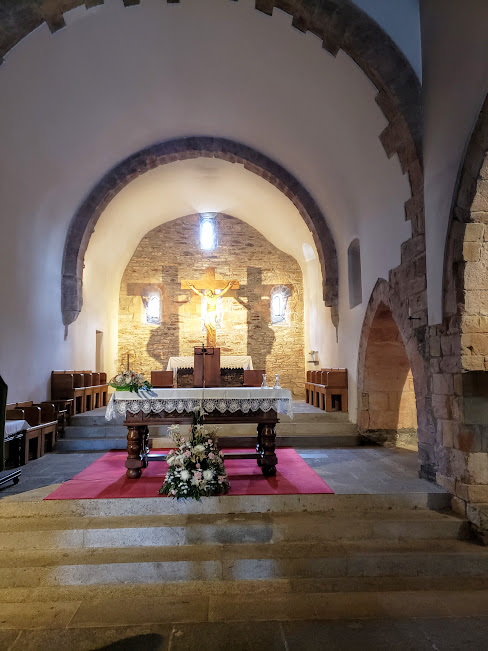
20190917_112709

Don Elías Valiña Sampedro (Born in Sarria, Spain on February 2, 1929 and died December 11, 1989) restored and revitalized O Cebreiro. But not only that, he’s integral to the Camino de Santiago’s recent revival. He was the creator of the YELLOW ARROWS that now mark the way for hundreds of thousands of Camino pilgrims every year. In his love of the Camino and its importance, Don Elías Valiña Sampedro has made O Cebreiro a treasure on the historic route.

If you want to immerse yourself into a fictional story that takes place with the Camino de Santiago as its backdrop, check out my recently released novel THE CAMINO CLUB. Here’s a LinkTree to buy options and reviews on Goodreads: https://linktr.ee/Kevintcraig

When you reach O Cebreiro, your journey to Santiago is far from over. The mile markers will tell you so. But have faith, it gets easier…

159.69KM to go to Santiago de Compostela…