When You Finish a Novel that Consumed You

There’s nothing like typing THE END at the bottom of your MSWord document. It is a distinct kind of joy and sorrow to do so. On the one hand, there is a great sense of accomplishment. On the other, you are sadly saying goodbye to great friends. It is the hug that wounds, the kiss that burns, the cut that feels so good.

After living inside the Camino de Santiago for the past month, retracing my own steps for the sake of my characters, I am exhausted-spent-exhilarated-lonely-happy-thrilled-gutted-euphoric-elated-dejected-emotional and fragile and infinite and empowered. And a few other emotions thrown in for good measure.

If you’re a novelist, you know the feeling.

My young adult novel The Walk–or The Camino Club (I cannot decide)–has been put to bed. It will be what it will be. I need to strike that pilgrimage place from my list of obsessions for a spell. The Camino itself fully consumed me while writing that novel. From watching the movie THE WAY on repeat, to listening to the same movie’s soundtrack on repeat, to reliving my own Camino experience through memories and photographs…I swear I feel like I just got back from Santiago de Compostela today. So powerful was the spell it has had on me these past weeks.

Goodbye Santiago de Compostela. I love you so much. And I love the characters I created to walk the path towards you too. Goodbye Diego, Shania, Manny, Troy, Greg, Claire, Meagan, Gilbert, Kei, Mia, Becky, AND Bastien. Buen Camino!

But there is nothing to do after finishing a novel, but to jump into the next one. Whether that be returning to a work in progress or starting something new. To dally would be to get out of the habit. So, onward. Back to the novel I began in Brussels this past May. It needs to be completed. Today, I turn the page from Spain and open a new one on Brussels. I swear, these settings are consuming me just as much as these characters.

BRUSSELS2
Time to revisit Brussels, one of the few settings for my current young adult WIP. This is me in Grand Place, the beautiful square in the heart of Brussels, just two minutes from where I stayed this past May.
wp-image-109302426
My upcoming release PRIDE MUST BE A PLACE is now on GOODREADS. Click the image above to swing on over to GOODREADS and add #PMBAP to your shelf! It drops February 6th, 2018.

The Monster of Passion

If you’re anything like me, your story sparks blow up while you’re trying to keep ahead of them.

Recently I began to write a short story for a contest I wished to enter. When I see local writing contests, I like to enter as a way of showing my support for the organization that is hosting them. The intention is never to place in the contest. I don’t have enough self-esteem to hope for that to happen. If it does, even better. But if it doesn’t–if I just happen to be one of the paying entrants whose money helps to support the continuation of the contest in the future–well, I’ve already won. I like that these writing opportunities exist.

I haven’t forgotten the thread of this post. It’s actually about the short story I penned for the writing contest. Or rather, it’s about what happened when I took on the spark of an idea that prompted that original short story. Perhaps it was the subject matter itself–the Camino de Santiago–but I doubt it. Because it happens a lot, no matter the subject matter. I begin to write one short story, and, like a horse in a race it begins to make its way to the finish line while I struggle to keep up with its frenetic pace. What happens next is typically what happens in a horse race. While the horse and I are tearing up the track, another more urgent horse comes barrelling up alongside us.

The second horse in this analogy, as you may have guessed, is another spark for a short story idea…which stemmed from the original. Do I get off the first horse and hop onto the second? Probably dangerous, right? It may kill my momentum and fizzle out the writing fire I’ve begun with the first story. If I try to jump to the second horse, I may fall and end up horseless.

Here’s where multi-tasking comes in to play. No…I don’t try to write both stories simultaneously. That’s like straddling both horses, and it’s almost always a catastrophe in my own personal experience. I DO jot down a few of the second story’s more pertinent sparky little details before I lose sight of them, though. I can do this while maintaining my pace with the first horse.

If you’ve ever been to the races, you’ll know there are very seldom (never) races which involve only TWO horses. Enter horse number three. If you’re feeling a bit of stress reading this and realizing that the Creative Spark Fairy is often a sadistic bastard, you’re not alone. I’ve known this for quite some time.

So there I was, writing my short story for the writing contest and knowing the deadline was RIGHT AROUND THE CORNER. I mean, at the stroke of midnight my time to submit it would be up. And a third horse came up alongside me. “Hi. Look at me. I’m another story!” I can’t hush these sparks. They demand attention. They insist that you juggle them. They want to be told. Our passions are monsters…they take hold of us in the best possible way. They make us better.

Maybe it’s a matter of being really good with a lasso? When I was 5ish I lassoed the family television and pulled it around the living room, so I happen to know that I am exceptional with a lasso. (Before you ask, yes I did get permission to do this prior to doing it. I’m not crazy. My parents, on the other hand, may very well have been. They should always pay attention when their most rambunctious child is asking them a question. Especially when he’s twirling a lasso over his cowboy hatted head while asking it. It’s like they never learned.) So, back to the horse analogy. I DID manage to stay on my first horse and race him to the finish line in time to complete and submit the original short story prior to the submission deadline. Yay, me! What I also managed to do was lasso the other two horses and get them to keep pace with me so that I could explore the sparks that created them in the first place.

After the first story was submitted, I hit the ground running with story number two. The thing about this particular subject matter was I can think of a hundred thousand stories that take place on the Camino. When I walked it, I met so many people from so many different countries. And I got snippets and tidbits of their stories while I walked. People open up on the Camino de Santiago. They whisper to fellow peregrinos some of their deepest most private thoughts. They share their lives.

So when I started that first story, about a woman walking the Camino in order to find a way back to who she was before she identified solely as a wife and a mother, more people came up to me from the deep well of creativity that the Camino inspires in me. I wrote about Helen and that second horse, Corinne came barrelling up and said, “Wait…I too have a story that you can tell.” And then a third horse, Richard, came up and pleaded, “No, tell my story.” And it just snowballed from there.


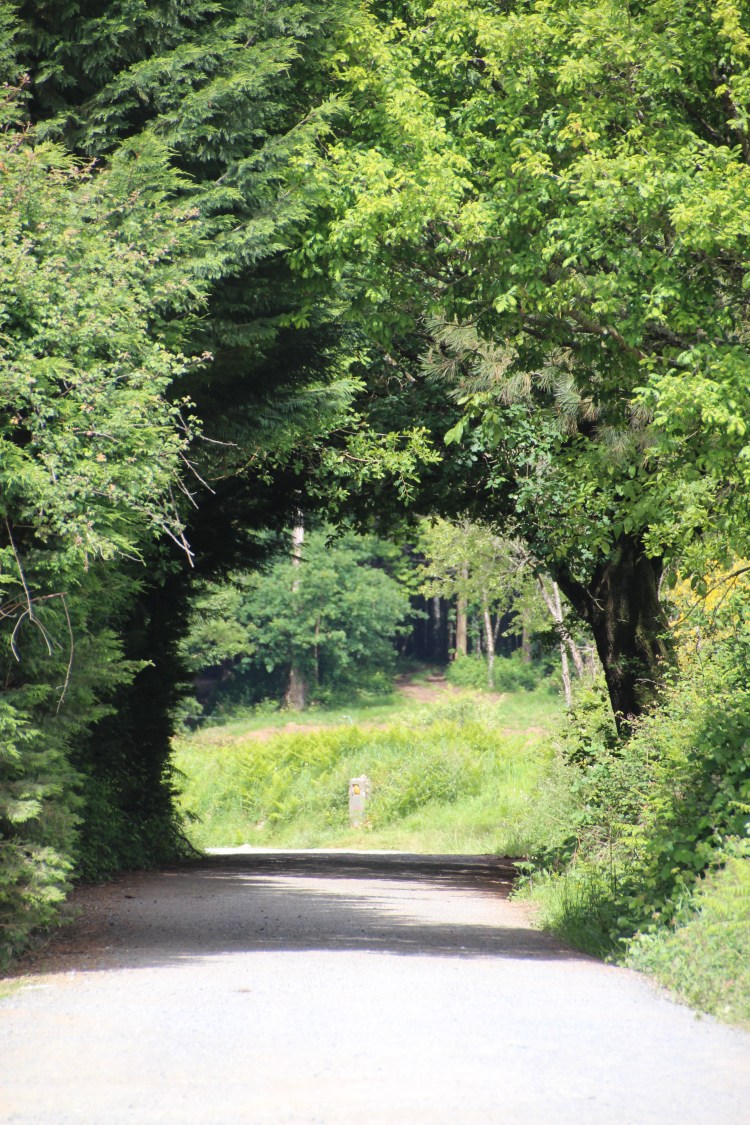
Images from Portomarin, Spain…one of the multitude of beautiful and inspirational places along the Camino.

Usually when this happens with a spark I do see a few projects through. But often I only use one of them. Often, it’s the original that goes out into the world. But it’s also at times the third or the fourth or the fifth story that I eventually end up using. I never consider the unused ones to be a waste of my time, though. Every spark becomes a horse race. And horse races are fun. I enjoy exploring all my options before I settle with the winning horse. And then there are the times that a subject matter possesses me so thoroughly that the topic comes up across the board in my writing life. I’ll write plays, novels, short stories and poetry from the same well. It’s the only way I know how to exhaust the well. Get all my horses to the finish line. Then and only then can I move on to the next spark that inflames my passion. This Camino race? It certainly has a lot of horses in it. I suspect this race will be off and on for the rest of my life. Its horses are strong and fierce and filled with spunk. It’s a horse race without a finish line. And I’m good with that. I have to be. I’m a peregrino.
img_2108


The Stage or the Page? Writing the Baby or the Embryo

I was recently asked the question, ‘What do you like writing for more…the stage or the page?’ My answer was simple. I didn’t even have to think about it. It was an emphatic YES!

With a gun to my head, along with the pressure of having only ten seconds to either give one up or die, I would probably use the little time I had left to say goodbye to loved ones. Admittedly, the decision is not Sophie’s Choice or anything as life or death crucial as that…but it feels that epic. It’s a choice I would never want to make.

I always say that writing for the stage is like writing a novel without having the added responsibility of working with all that clunky, incipient prose that shows up between the dialogue. That’s why I love being a playwright. I need only worry about putting words into my characters’ mouths. All the movement and action (business) can be on the director and actors to decide. All the setting can be created by the set designers. The rest of the theatre crew deal with all that prose that doesn’t have to be there on the page. At times, that feels like getting a get-out-of-jail free card. Score! I can have fun just making my characters talk!

And it’s a lot of fun. But…there’s also something missing. I absolutely love building worlds and making sure every little detail is as it should be. The reader will hear the dialogue in a novel. And that dialogue better be authentic. There’s nothing more irritating than dialogue that simply does not sound authentic. But the reader will also see the prose. How they see everything that surrounds the dialogue is up to me. I love getting that right. I would sorely miss that if all I did was write plays. Yes, a playwright works with stage direction…we do use prose outside of dialogue. We have to at least let the rest of the theatre crew know the scaffolding that surrounds the conversation. But we don’t get to visit the minutiae of the scenes we create. I love to write my novels cinematically. I write so that the story rolls out as though it were playing out on the big screen. I like to be in control of all the details. In order to do that, I need to embrace all aspects of story. I need to paint the scenes in full.

On the stage, it’s all there in front of the audience. To an extent, what they see is the playwright’s vision. But in another way, it could be diametrically opposed to the playwright’s original vision. Outside the characters on the stage, and the words they speak, most of what the audience is seeing is director, actor, and set design interpretation. This isn’t a bad thing. Playwright’s understand that they are, in a sense, giving up a lot of control when they write for the stage. That is, in fact, part of the thrill of play-writing for me. I love to see what the other people involved in my plays do with them. I love watching the actors form their characters. Ultimately, I end up loving the characters they create a lot more than the ones I sketched out. And the directors seem to know exactly where to put the business of the play. It’s an art-form to move the actors about the stage and have them perform the best possible movements at the best possible times. That’s why a good playwright will keep the stage direction to a bare minimum. They know that the next stages of the play’s development will be for others to interpret. A theatre company is a cohesive unit. A lot of work, and a lot of trust, go into making a good play.

In the end, the difference between playwriting and novel writing comes down to collaboration. While I’m writing my novel, I want to be the director, the actors, the set designer, everything. I want to have full control. I understand that at some point an editor will come in and make crucial improvements upon my creation, but I don’t take that into consideration while I’m creating. While I’m writing my play, I have forethought. I consider that the director and actors will work with what I give them. I understand that the creation process will still evolve when I am done with the words on the page.

Ultimately, it takes a writer to create a novel and a village to create a play. So don’t ask me what I would rather do. I love the solitary world of novel writing. I love to sit down and write something and present it to the world complete. Voila! But I also love to collaborate with the wonderfully creative and talented world of the theatre. I love being a part of something that is so much bigger than me, but that ultimately starts with me. When you write a novel, you pass your fully formed baby on to the world. When you write a play, you’re passing an embryo on to doctors who will know exactly how to bring it to fruition. I’m okay with both methods. As a writer, I’m blessed to have experienced both. So take that gun away from my head. I have a novel AND a play to write.

You can catch 2 of my plays on TUESDAY AUGUST 1st from 7pm-9pm in PORT PERRY, when they are to be STAGE READ by the folks at Theatre 3×60. Click the image to visit their page and purchase tickets ($10 gets you in to see both plays read — The History of Us AND King of the Crease)