How to Write a Novel in ONE Sitting

Stop balking. It can be done! I’ve done it. In fact, it’s the best way for me to write a novel. Trust me. You do not want to be inside this head. I have the attention span of a–well of something with the most minute of attention spans in the history of attention spans. I prefer not to say a gnat, because, well does anybody actually KNOW what the attention span of a gnat is? For all we know, they could have a superior attention span. That’s attention span bigotry, in my humble opinion.

What was I saying?

Oh yes. How to write a novel in one sitting.

Having done this on several occasions, I could probably give a few tips on how to do it. The most important thing for me is to not take myself too seriously when I do this. Don’t get me wrong…I take my writing output very seriously. The finished product must be as close to infallible as possible. But writing…the actual act of sitting in a chair–or on a chair–or on a table–or on the floor–and writing? I can’t take that too seriously. F to the U to the N. That’s what I require when I decide to give my writing self 72 hours to come up with a complete novel. Stepping into a novel marathon situation with a sneer and a steel resolve to GET THINGS DONE would equate to ABSOLUTE FAILURE for me. If you think you can attack a marathon writing situation by approaching it without humour and with a resolve to GET SHIT DONE, by all means…give it a go. That’s not me.

Here are some points to consider prior to hunkering down for a one-sitting first-draft novel:

1. Remove all commitments from your schedule. This should go without saying, but you would be surprised. Don’t schedule a one-sitting novel writing jag with a doctor’s appointment in the middle of it. That’s a real life break. You can’t have real life breaks. They interrupt the flow of the marathon mind. That shit will fuck you up. Make sure your schedule is COMPLETELY open. No “I have to watch Matlock Saturday at 7pm…but that’s the only break I’m taking!” You can’t have things to distract you from the trenches. You can take breaks…I’m not saying you can’t. I’m just saying you can’t have REAL LIFE breaks. You can’t come out of the cave.

2. If you don’t have somebody looking after your dietary needs for the marathon sitting, make sure you have enough previously prepared food to take you to the end of the marathon. Refer to #1. Preparing yourself a 3-course meal on day two of your marathon would be a lovely reward for sticking it out, but it would also take you completely off course. Might as well pack it in, because your mind left the cave as you sliced the onions and mashed the potatoes. Nothing kills a creativity binge more than straining broccoli through a colander. Have everything you need for your meals readily available. The most you’ll want to do in the kitchen is nuke things in the microwave or send some bread to the toaster gallows. More than that, and you’re disturbing the force, Luke.

3. Stand up and move away from your screen whenever you desire. Writers know that not all of the writing is done in front of the screen. You can leave your shelter all you want, you just can’t leave your cave. Take a walk down the street. Do jumping-jacks or gestalt or scream therapy. Walk down to the water and jump in. Now you’re thinking ‘why can’t I peel potatoes when I can jump in the river?’ Don’t question me, grasshopper. I have done this several times. Just think yes to FRIVOLOUS ACTIVITY and no to CHORES. You can do one while remaining in your writing cave, but it’s hard to remain in the cave while doing the other.

4. Listen to music OR don’t listen to music. This is, of course, a personal choice. A lot of writers have PLAYLISTS for their novels. If you know what you’re going to write about during your marathon jag, create a playlist prior to entering your cave. Listen while you write, if that’s your thing. Or, if music during writing makes you want to pluck your eyeballs out, then don’t do it. The key is if you’re going to listen to music, have everything you need for it at your fingertips. Creating a playlist while you’re in the cave could be catastrophic to the force, Luke. You’ll think about searching for a certain song, and you’ll go to download it or what have you. Next thing you know, two hours have passed and you’re in some dingy basement backroom of Youtube, watching/listening to a 1970s bootleg concert of Patty Smith and you won’t know how to escape. You will have to surrender the fantasy.

5. Take a boatload of writers with you into your cave. There are now several novel marathon events around. Find one…participate in one. You will thrive on the camaraderie of being in the company of other writers while doing this seemingly impossible thing. You will feed off of each other in the most positive of ways. And you will walk away from your weekend (or mid-week jag, if you will) with not only a finished first-draft but a load of new siblings in writing. Relationships will be formed that you will carry with you for a long time.

6. BE FOOLISH. Allow yourself to laugh. You are doing a phenomenal thing. To write a novel from cover to cover in one sitting is extraordinary. You will be tired (EXHAUSTED), you will be emotional (A WRECK), you will be excited and wired and down and up and sideways. Don’t try to hold everything in. Don’t try to make this a pseudo-military mission. There are no rules. There is only you and the unfolding story. You have to have fun. It’s the only way to get through it. Trust me on this. You’ll have some great moments. Breakthroughs will be everywhere. But at 2:30 in the morning on your second day you might want to pull out all your hair and set your legs on fire. You will be giddy to the point of crying…but remaining in your cave is the way through it. Let seriousness fall away and be your child-self. It’s how you will make it through the dark tunnels of the marathon. WRITE YOUR WAY THROUGH.

7. Whatever you do, don’t look back. Writing a novel in one sitting is not like seeing a runaway freight train bombing down the tracks at an impossible unstoppable speed. Writing a novel in one sitting makes YOU the freight train. Don’t, for the love of god, stop that train. You have to let go of the ego self that screams at you to edit that last sentence, that last paragraph, that last chapter. The editing can come later. Much later, if you want. During the marathon, there is only ONE DIRECTION. Forward.

That’s enough for now. The biggest thing about attempting to write a novel this way is that there are no rules. YOU FIND YOUR OWN WAY. These are just a few loose suggestions. (-: You have got to try to write this way. It’s so liberating. Magical. Imagine not needing to do anything else between the start and end of your story. It’s unfathomable, but not impossible.
 

How to Write a 10-Minute Play

So, I’ve been writing the ten minute play for a number of years now. I’d like to think I’ve been doing it with a bit of success, too. Though one could never be sure. I can attest to the fact that the audiences seemed to like my work. Being in an audience when they’re laughing during the unraveling of a comedic play you wrote is extremely rewarding. I consider myself blessed to have experienced that. But I’m rather hard on myself, as a writer…so I tend to allow the actors and the directors to take the blame for the laughter. (-: After all, the script is merely the scaffolding. Right?

So, now that I have had seven 10-minute plays produced…I feel I may be able to offer some advice for others considering the 10-minute play market. It is a favourite of mine. A good 10-minute play can contain the world within its rigidly timed existence. You just have to work like hell to contain it.

1. I learned the hard way that there is a world of difference between a sketch and a play. If your characters are not transforming and going through some kind of self-revelation, you could very well have written a sketch. A play is a complete story, whether that play is 10-minutes long or two hours long. You need an arc. A conversation where nothing really happens and no wisdom is gained and no change takes place is simply a conversation. A lot of first time 10-minute playwrights make the mistake of creating a sketch when they attempt a play, myself included. Last year, during the InspiraTO Festival in Toronto…there was a last-minute call for a play in one of the festival’s satellite locations. As I already had a play in the festival, to take place on the Alumnae Theatre stage, I received the call automatically. I jumped on the opportunity. By the end of the day of the call, I sent in what I mistakenly thought of as a play. Fortunately, it seemed to have some good bones. The Artistic Director, Dominik Loncar, worked with me to flesh out my idea and bring the sketch into the realm of play. I think working with Dominik to create this play was one of the most educational experiences I had in the playwriting process. So, always make sure your play is a full story which culminates in a character change.

2. This one is so easy, it seems self-explanatory. But I have often struggled with it myself. So, I know it needs to be said. For those of you who follow guidelines to a tee, this rule should not be a surprise to you at all. For those of you who think it’s perfectly natural to send a 7,000 word story into a magazine whose submission guidelines clearly state ‘stories should be no more than 3,000 words’, please take heed. There are guidelines for a reason. Ignoring them is the first opportunity the publisher/producer/what-have-you has of culling the pack and rejecting you. Don’t make it easy for people to reject you. ALWAYS read and follow the guidelines. I know from personal experience that well over 50% of submissions are sent in by people who prefer to think of themselves as above submission guideline parameters. As a past acquisitions editor, my job was made quite easy by those who ignored guidelines. I’ve gone on long enough. I tend to get ranty when I discuss writers’ inabilities to follow guidelines. #2 of my advice is that you ensure your play is 10-minutes in running time. NOT ELEVEN. NOT TEN AND A HALF. TEN. End of story. I ‘perform’ my plays over and over again to ensure they meet this criteria.

3. Stage Direction. Use it wisely. Actors are brilliant. While developing their character, they soon learn everything about who that character is. From that place, they can see how that character moves. You don’t want to fill your play with minor business (BUSINESS is the term for what is happening within the play that is not dialogue). If there are necessary directions you feel would move your play forward, by all means include them. But please trust implicitly in the actors and director. They’ll know how to include the right business. I’m sure it infuriates these people no end to be told through stage direction each and every step and movement they are to perform.

4. Give your character a WANT/DESIRE. And then put obstacles in her way. This will create tension. Tension is good. Tension is necessary. Your character needs to propel–be propelled–into the heart of the play. Nothing moves a character more than a shiny carrot dangling just outside of their reach.

5. I think there’s a fine line between KEEP IT SIMPLE and GIVE IT PIZZAZZ. Keeping it simple is required. You only have ten minutes to tell a full story, to bring a character from one place in their life to another. This is not a movie. You can’t have extraordinary props. Your goal is to get to the audience’s raw nerve–be it through comedy, drama, fear, what-have-you. Leave the glitz of the movie world on the silver screen. But this is not to say you can’t give your play pizzazz. You want to make it theatrical, larger than life. You can do this without explosions and special effects. You need to find a perfect balance between simple and exciting. Think of simple as budget-related. Often, you’re working with bare-minimum stage props. Think of exciting as character-related. Give your characters great dialogue and a great compelling story the audience won’t be able to tear themselves away from. Make the walk to the climax a dazzling crescendo.

The best advice I could give someone who aspires to get into the 10-minute play business? Surround yourself with people in the know. Approach theatre groups. Take in 10-minute festivals in your area. Nothing teaches one more about writing than reading. Nothing teaches one more about 10-minute playwriting, than watching 10-minute plays. Don’t be afraid to write a play and submit it. There are 10-minute festivals all over the world, now. You don’t have to have the title of playwright to write a play. That comes after. Just dive in!

(I’ve had some great opportunities from people willing to take a chance on an unknown quantity. 10-Minute festivals are a great way to get your foot in the door of live theatre. Without people like Jeremy Smith of Driftwood Theatre and Dominik Loncar of InspiraTO Festival, I’d still be dreaming about being a playwright…instead of being a playwright. Go forth and find your way in.)

Suggested Reading: The Summing Up by W. Somerset Maugham


You can check out my novels at my AMAZON AUTHOR PAGE They are: The Camino Club, Book of Dreams, Summer on Fire, Sebastian’s Poet, The Reasons, Burn Baby Burn Baby, and, Half Dead & Fully Broken. The horror anthology Purgatorium, which includes a short story by me, is also listed there.

Sorry! This product is not available for purchase at this time.


Me and the Camino? Why not…

I recently decided that I need to walk the Camino. In much the same way one lost in the desert decides they need water. It’s a long story.

I have been lost for a very long time. When one is visited by trauma in early life, one often gets misplaced from the life they would have lived had the trauma not occurred. I think I did a pretty good job these past few years rediscovering that long lost potential life.

Since around 2002, I’ve been writing. I believe writing to be my calling. I don’t know if I’m any good at it, but I know it makes me a better person. Does one have to be a master at something in order to believe that thing to be their calling? I don’t think so. I think it’s in the doing of the thing that one finds its true value, not in the quantifying of one’s ability in doing the thing. The possibility of kudos should not be the determining factor. My calling is writing. Because it is while I am writing that I feel most like the person I imagine myself to be. It defines me. I’m defined by it.

There was a time when I thought rediscovering my passion would be enough. I would find my happiness in doing the thing I was destined to do. Over the past decade, though, I discovered I couldn’t be further from the truth. It’s not enough to reach your calling and sit on your ass. One must always plow forward. One must always be in a state of learning and personal growth. Sure, getting BUM IN CHAIR is an awesome and integral part of being a writer. I know this because I practice it.

But discovering and embracing my calling was not enough. Not by a long-shot. I was still a severely damaged human being. I was just slightly happier because putting words to paper seemed to keep the demons at bay, even if only momentarily.

I now know I needed to do more. I needed to face the demons in my life. If you are ignoring trauma, it doesn’t go away. It feeds off of you. And it grows. And grows. And grows some more. The only way to euthanize it and take back your life is to pull it out from under the rocks and face it down.

I heard about the CAMINO years ago. I took part in the 2007 Great Canadian Winter Novel Marathon at the Pickering Public Library and two of the other participants were this dynamic woman and comical man who, together, formed this kind of Superhero Duo. They were writing a novel together. At the time, the concept kind of blew me away.

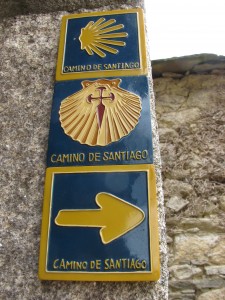
The duo were Sue Kenney and Bruce Pirrie. I later learned about the Camino through Sue. AND since I first heard about it, I knew I had to walk it. I knew in my heart. I knew in my soul. I knew in that place where you just know. The Camino called out to me. I’ve since learned that one really doesn’t choose the Camino. The Camino chooses you. When it is your time to take the walk, you will know. It will become not just thing that you once heard about, but this thumping thriving living breathing thing inside you…a force that tells you to cross an ocean. When the Camino knocks, you put down your things, find the nearest walking stick, and start waking. <<that was a fortunate spelling error–I accidentally left out the l in walking. I think it’s kind of apropos, though…don’t you.

Turns out, since the first time I met Sue, she has discovered her own new callings. She now guides tours through the Camino. CLICK HERE TO LEARN ABOUT HER MAY, 2014 GROUP CAMINO JOURNEY.

I have quite a bit of baggage to shed. And I have this rock I must leave along the Camino. I must leave it there, like others who find themselves lost in the desert must have a drink of water. I took the rock away with me when I left a Male Survivor Weekend of Recovery retreat. The rock is from a mountain top in Ohio, U.S.A. This summer, I had a moment when I knew I should leave it at our fire-pit in Muskoka, Ontario, Canada. But now I know I was wrong. Or, perhaps it only wanted to spend a season in Muskoka. Before I head for the Camino in May, I’m heading up to Muskoka to retrieve the rock.

You may think, “It’s only a rock. Why’s he making such a big deal?” A Weekend of Recovery retreat sees some thirty men participate in a fully interactive program to help them along the journey of recovery from the scars of sexual abuse. The larger group breaks down into smaller groups…and it is in these smaller groups that each participant chooses a rock from the grounds of the facility (which, for me, was at Hope Springs, in Peebles, Ohio). It is what these smaller groups do with the rocks that give them power and meaning. Each participant of the smaller group holds each rock in their hands. This symbolizes the strength we have together. Each participant walks away with a rock that was in the hands of each survivor in their small group.

Believe me…when I’m having a bad day, getting that rock out and holding onto it…it helps me to reflect on the weekend and what I learned there. I have been to Hope Springs two times. The first year, one of the other members in my small group actually gave me HIS rock. I’ve had it in my pocket every single day since October, 2011. I’m sure I’ll never be without it. But the rock I received the following year, I felt that I needed to plant it somewhere significant. And I thought maybe leaving it in that significant place would give all of us in that year’s small group a degree of power. I would be leaving a piece of US in that place.

I honestly thought Muskoka was the final resting place of that rock. But now I know differently. I’m walking the Camino to place it at the Cruz del Ferro site. This site is an iron cross atop an enormous pile of stones…stones left over the centuries by past pilgrims. This is the place I need to deliver my rock to…and in-turn deliver my brother survivors to.

I believe there is still room in Sue’s 2014 Journey. Click on the picture below to learn more.

Group-Camino-Pics-May-2010-start-200-225x300